


About the Author:
Jeff Kozloff brings more than 25 years of leadership experience across pharmaceutical, clinical, and commercial software. He has scaled multiple investor-backed companies through critical growth phases, including serving as CEO of Verilogue and TrialScope. He also currently serves as Chairman of the Board at ProofPilot.
Talk with people about eSource long enough and the conversation inevitably hits a basic question: where does source data actually come from?
The easy answer is “the site.” But a single Phase III study might enroll patients at an academic medical center, a community cardiology practice, a regional hospital, a large, multi-location dedicated research organization and a remote dedicated research single-site, often times in the same week. Those sites don’t capture data the same way. If we’re serious about real-time clinical trials, we need data from all of them, including the ones that are hardest to connect with.
What the site mix looks like
Our friends at Citeline, a Norstella company, were kind enough to pull some numbers for us from their SiteTrove data, which is about as close to a census of trial sites as our industry has. Thank you to Christina Masturzo and the Citeline team.
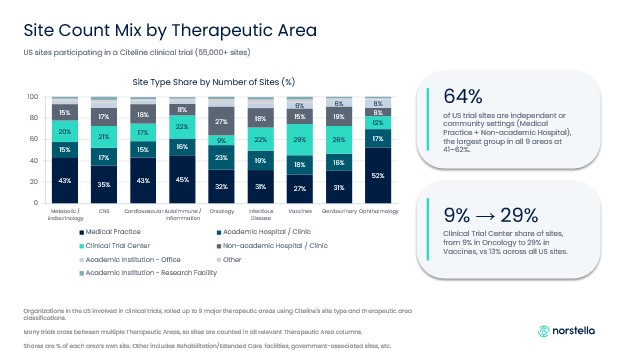
Source: Citeline (SiteTrove), a Norstella company. Share of US sites by site type; sites active in more than one therapeutic area are counted in each.
The data covers more than 55,000 US organizations that have taken part in clinical trials, grouped into nine therapeutic areas. A few things jumped out at me.
Community care settings, meaning medical practices and non-academic hospitals, are the biggest group in every therapeutic area. They make up between 41% and 62% of sites, lowest in vaccines and highest in cardiovascular. Across all US trial sites, it’s 64%.
Academic institutions come in at roughly 20% to 29% of sites, depending on the area. Dedicated clinical trial centers swing the most: 9% of oncology sites, 29% of vaccine sites, and 13% overall.
No therapeutic area runs on a single kind of site, and sponsors need every kind to fill enrollment.
Three kinds of sites, three kinds of source data
At an academic medical center (AMC), the patient is usually there for clinical care. More and more of the research data comes out of the EHR, and EHR-to-EDC work has come a long way (our friends at IgniteData are doing great work here). Still, EHRs were built for care and billing, not protocols, so a lot of study-specific data ends up in notes, worksheets or on paper.
Community practices and hospitals are the biggest slice and the hardest to generalize about. Some have strong EHRs, some also use research eSource, and plenty still run study visits on paper and transcribe into EDC later. Their patients count toward enrollment like everyone else’s, so their data matters just as much.
Then there are dedicated research sites, large and small, urban and remote, where patients come in only to take part in pharma and biotech studies, not for traditional clinical care. Often there’s no EHR encounter at all, so the research record is the source record and purpose-built eSource is the obvious fit. This is where RealTime started, and it’s still our core.
None of these setups are wrong. Each reflects the work the site actually does and the investment it has already made. A sponsor needs data from all of them, and ideally needs it as it happens.
Bring your own tech
Any vendor, us included, could make a tidy argument that every site should move onto one platform. I don’t buy it. Sites have spent years building infrastructure that works for them. Asking an AMC with a mature EHR, or a small dedicated practice, to adopt yet another system slows study startup and shrinks the pool of sites willing to say yes.
Instead, we’re advocating for “bring your own tech” (BYOT). Each site captures source data in its system of choice, and that data travels on a standardized rail that sponsors, CROs and technology providers can all plug into.
Other industries got there first.
- In the 1800s, American railroads were built on different track gauges, so cargo had to be unloaded and reloaded wherever two lines met. In 1886, the Southern railroads re-gauged thousands of miles of track over about two days to match the rest of the country. They went right on competing for freight. They just agreed on the track.
- Banking works the same way. My bank and yours compete for customers, but money moves between them every day over shared networks like ACH. No one has to change banks to pay a bill.
- Life sciences has done it too. CDISC gave sponsors and vendors a common format for study data, and FDA now expects submissions in it. TransCelerate, launched by a group of large pharma companies in 2012, took on shared headaches like site qualification and GCP training that no single company could fix alone.
Source data should work the same way. Let companies compete on how good the experience is at the site, and cooperate on how the data moves.
When competitors collaborate, science wins
Real-time clinical trials won’t come from a single vendor or a single type of site. They’ll come from a common rail that carries source data from all of them: the academic center’s EHR, the community practice’s system of choice, the research site’s eSource.
That rail only works if the data is digital where it’s born. You can’t unlock the value of real-time trials off a paper chart that gets transcribed into EDC days or weeks later. To enable real-time trials, the industry should help sites still on paper move to the eSource system that fits them best.
Getting off paper pays off long before anyone says “real-time.” When data is captured electronically at the source and flows straight into EDC, nobody has to transcribe it, and nobody has to send a monitor on site to check the transcription. That cuts source data verification and in-person monitoring time, which the risk-based approach ICH E6(R3) encourages. Site staff get hours back from double entry and query cleanup, and sponsors see clean data sooner and can lock databases faster.
RealTime’s eSource runs at dedicated research sites and a growing number of community practices, and we’re proud of that work. But no single vendor covers every kind of site, and a trial needs all of them to enroll and finish.
Citeline sharing its data with us is a small example of the kind of cooperation I’d like to see more of.
From October 15 to 18, a lot of us will be in Orlando for SCRS’s Global Site Solutions Summit. It’s one of the few rooms where sites, sponsors, CROs and technology companies, plenty of them direct competitors, sit down together around the same problem: making research work better for sites and the patients they serve. We’ll keep competing for business, and we should. But a rail that carries source data from every kind of site is something we’ll have to build together.
If you’re going to be at SCRS, come find me. And if you build site technology, run sites or sponsor trials, I’d welcome the conversation.