
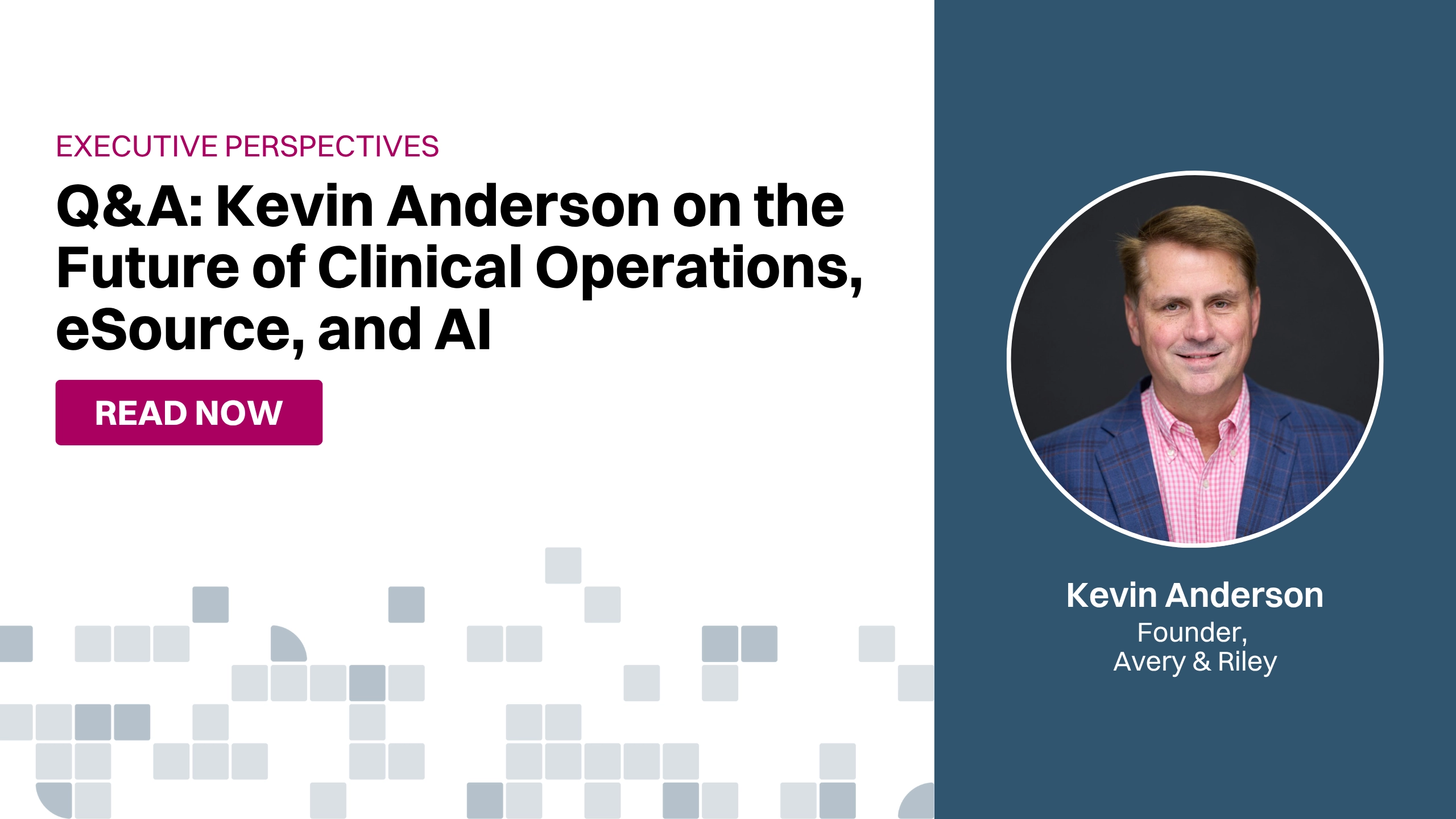
Disclaimer: The views and opinions expressed by Kevin Anderson are his own and do not necessarily reflect the official position of RealTime eClinical Solutions.
Clinical operations is entering one of its most significant periods of transformation in decades. Advances in eSource, AI, and risk-based oversight are challenging long-standing assumptions about how sponsors monitor studies, manage data, and collaborate with research sites. The result isn’t simply new technology; it’s a fundamentally different operating model for clinical trials.
To explore where the industry is headed, we spoke with Kevin Anderson, Founder of Avery & Riley, and a clinical development operations executive with more than 30 years of experience leading global programs across biotech and pharmaceutical organizations. Today, he advises biotech companies and AI solution providers on applied AI strategy, clinical operations, and the future of drug development.
Monitoring is one of the highest operational costs in clinical trials. Where do you think the biggest opportunity for improvement exists?
Kevin Anderson: Easily 50–60% of monitoring effort goes toward source document verification. That’s an enormous investment of time.
The biggest opportunity is moving from source document verification (SDV) to source document review (SDR). Making that shift requires reliable, structured source data and workflows that allow teams to focus on meaningful exceptions and risk signals rather than manually verifying every data point. If we can make that shift, I believe we could cut monitoring effort in half, or more.
Just as importantly, we give highly trained clinical professionals their time back. CRAs manage multiple studies, systems, and processes simultaneously. Too much of their day is spent on manual activities like SDV instead of applying their expertise where it has the greatest impact.
Sponsors have been talking about reducing monitoring costs for years. Why hasn't electronic source (eSource) adoption moved faster?
Kevin Anderson: Honestly, I think it’s because our industry tends to repeat the same processes without challenging them.
A good example is rare disease research. For years I defaulted to academic medical centers because that’s how we’d always approached those studies. It wasn’t until I started looking more closely at site networks and their processes that I realized there were other excellent organizations too.
Technology isn’t always the biggest barrier. Sometimes the bigger challenge is changing the assumptions we’ve carried forward for years.
What do people misunderstand about reducing SDV?
Kevin Anderson: The biggest misconception is that reducing blanket SDV means reducing oversight. It doesn’t. It changes where the oversight happens.
Instead of checking every data point exactly the same way, sponsors should focus on the sites, risks, trends, and signals that matter most.
What really changes is the monitoring model: less routine checking, more targeted review, trend analysis, escalation, and documentation.
And perhaps most importantly, that freed-up time can be reinvested into site relationships. That’s something that has been historically undervalued simply because monitors have been so busy completing manual work.
The industry is increasingly talking about the Bring Your Own Technology (BYOT) model, where sites use their preferred eSource systems rather than mandated technology. Why is that conversation gaining traction now, and what does it mean for sponsors, CROs, and sites?
Kevin Anderson: Sites are tired of learning a different technology platform for every sponsor. It takes significant time and effort to become proficient in one system, let alone several.
BYOT gives sites more flexibility while giving sponsors better audit trails and standardized data. Ultimately, it makes studies less burdensome for sites while improving the quality and accessibility of information sponsors receive.
I also think sponsors will increasingly prioritize sites that can provide cleaner data earlier because that makes studies easier to oversee and supports more effective risk-based monitoring.
You've said sponsors will likely start prioritizing sites that use eSource. What does that shift look like in practice, and how do you expect it to become meaningful site-selection criteria?
Kevin Anderson: Sponsors want sites that, of course, can enroll. That is more important than anything. But they want to gain access to more data faster, which improves decision-making.
I expect this to become most meaningful in site selection, where it can help identify sites that deliver cleaner data faster, require less oversight, and better support a risk-based monitoring model.
Some sponsors are exploring direct eSource-to-EDC data flow as a way to reduce manual processes and improve visibility. Beyond the technology itself, what operational changes must happen for that model to succeed?
Kevin Anderson: This is a dream scenario that would remove a ton of busywork, errors, and audit/inspection findings, not to mention saving both sites and sponsors a lot of time and money.
For the model to succeed, we need clear data standards, agreed source expectations, and robust training.
Everyone is talking about AI. What's real today, and what's simply hype?
Kevin Anderson: My honest take over the last 30+ years is that I’ve watched people throughout pharma spend an incredible amount of time buried in inefficiencies. For example, finding that email or tracker. Or shifting arrows and figures from Q2-Q3 in spreadsheets.
And while we’ve introduced many great technologies that improved quality and compliance, very few have fundamentally reduced end-to-end cycle times and costs.
The hype is believing that AI will magically solve every problem overnight.
What’s real, and this only applies to AI-forward organizations, is that the companies who inject AI into the majority of their processes across the lifecycle will, in time, get safer and more efficacious drugs to market 2-3 years faster, and that means many more saved lives than was possible until now.
Five years from now, what do you think we'll view differently about clinical monitoring?
Kevin Anderson: By then I imagine that monitoring will be much less of a visit-based activity and more of a continuous oversight model where quality and compliance signals are surfaced automatically and hopefully even sorted out and closed by the same systems.
I also think eSource will be much more common, and we will probably be asking why it took the industry so long to get there. Once source data is cleaner, more accessible, and available closer to real time, it becomes harder to justify old monitoring models built around delayed review and heavy manual reconciliation. I hope we get there quickly.
Read More: Is Your Site Ready for the FDA’s Real-Time Clinical Trial Model?
Read More: Why Building an Enterprise Operating Model for Clinical Trials Starts With eSource