
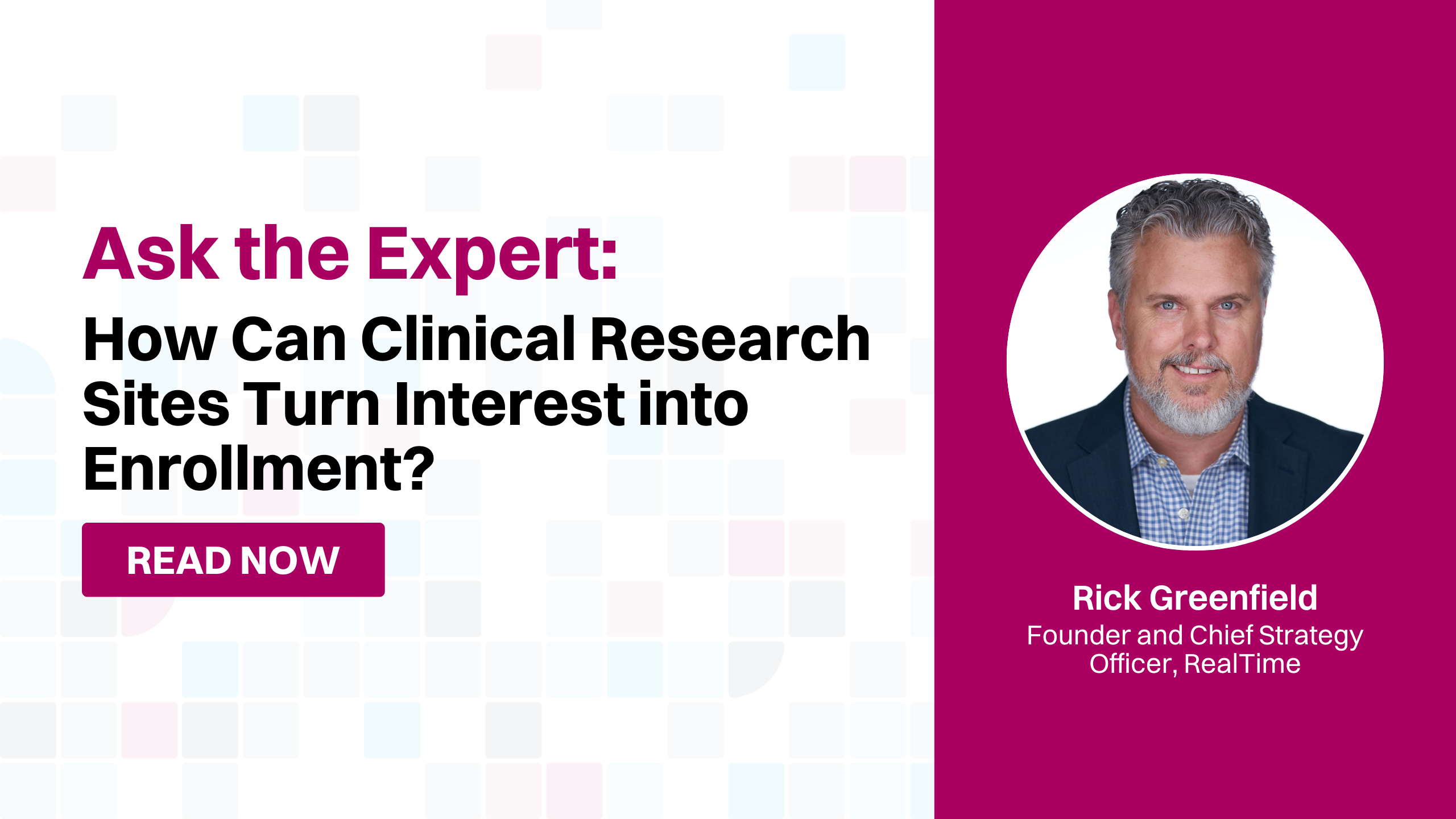
Featuring Rick Greenfield, Founder and Chief Strategy Officer at RealTime eClinical Solutions.
Locating patients interested in a clinical trial is hard. But getting them enrolled? That’s often where the real challenge begins.
In this edition of Ask the Expert, we speak with Rick Greenfield, Founder and Chief Strategy Officer at RealTime eClinical Solutions and former research site owner, to explore how clinical trial sites can improve the conversion from initial patient interest to actual enrollment – and why modern stipend practices, participant engagement tools, and streamlined workflows all play an important role in your site’s enrollment success.
Q: What’s one of the biggest drop-off points you’ve seen between interest and enrollment?
A: Honestly? It often happens right after the patient expresses interest. They might fill out a form, click a button, or call the site, and then… nothing happens fast enough.
Sites are busy. Staff are juggling studies. But that delay in follow-up can lose a potentially qualified participants. The longer the gap between interest and action, the more likely they are to disappear.
This is where workflow alignment and technology really matter. Automating immediate follow-up, segmenting based on trial fit, and tracking outreach are a few of the things that can really close the gap.
Q: Let’s talk about stipends. How do modern reimbursement practices influence enrollment?
A: Participant stipends matter more than people think. It’s not about “paying someone to participate.” It’s about removing barriers.
If a parent has to miss work, drive 45 minutes, and find childcare, that stipend might be the difference between agreeing to participate and saying no. But it’s not just the amount of compensation; it’s also how and when that’s delivered.
Sites using stipend systems like RealTime SitePay see higher enrollment and retention because participants receive reimbursements that are easy, fast, and transparent which builds goodwill and removes friction.
Q: What are some practical engagement strategies sites can adopt right now?
A: First, make sure your site is visible where patients are looking. Think about your website, social media, local health orgs, anywhere your targets eyes may wander.
Second, be responsive. Use tools like automated text response or direct texting with participants to respond to interest quickly. A study listing shouldn’t just be a static web page when it could integrate with your CTMS and lead to real, trackable conversations.
Third, give people reasons to stay engaged. With tools like RealTime’s MyStudyManager™ Participant Portal, you can send study updates, reminders, and even helpful info about what to expect at the next visit. Staying hyper-connected to participants reduces no-shows and builds a strong connection and commitment.
Q: You mentioned workflow alignment. What should sites be doing differently?
A: Sometimes departments are siloed, for example, recruiters collect interest and pre-screen, but CRCs manage screening activities. If those handoffs aren’t clear and tracked, the process can break and participants can be lost at the worst possible time – after they have been qualified through pre-screening.
Sites should map out the full recruitment-to-randomization journey and make sure your eClinical tools, like CTMS, Pay, Text, and eConsent, support it end-to-end. That’s where platforms like RealTime’s Site Operations Management System (SOMS) suite really shines — because data and communication flow across the whole system and across departments. Tracking a reporting of lead generation, campaign effectiveness, staff actions, participant communication, and conversion success are game-changers to your site’s recruitment potency.
And finally, review your actual time to follow-up. If it’s more than 24 hours, you’re likely losing people. Recruitment staff should follow-up with interested participants in minutes, not hours or days. You need a system that supports rapid response and ensures thorough follow-up until a pre-screening process is complete.
Real World Experience: Cedar Health Research
For instance, by connecting RealTime CTMS with Web Integration, Cedar Health Research strengthened its recruitment workflow. Here’s how it worked:
- RealTime’s CTMS Web Integration turned CHR’s website into a recruitment engine. When potential participants filled out online forms to express interest in a study, their information flowed directly into RealTime CTMS, automatically creating patient profiles and immediately alerting staff of a new HOT lead. This eliminated manual data entry, triggered immediate auto-response text messages to the applicants to confirm receipt of their application and next steps for connecting, and triggered real-time alerts for staff to follow-up immediately.
- With automated workflows inside CTMS, staff could instantly route leads to the right team members, track inclusion/exclusion criteria, and prioritize follow-ups without delay. What used to take over a week, manually sifting through forms and spreadsheets, became an immediate, same-day process.
The result?
- Screening times dropped from 7+ days to same-day contact and pre-screening
- Average time-to-first-contact improved by 98%
- More accurate tracking with dashboards showed funnel progress in real time
- A smoother, participant-friendly experience encouraged follow-through rather than drop-off
Cedar Health Research’s success proves that when your website, CTMS, and participant engagement tools all speak the same language, recruitment stops being reactive and becomes a proactive workflow for success.
Read More: Ask the Expert: What’s the Best Approach for Onboarding a. Site Operations Management System (SOMS)?
Watch This: How it Works – RealTime CTMS Web Integration